

Document, Monument, and Building Site. Piero Sanpaolesi and the Dome of Santa Maria del Fiore in the Twentieth-Century Culture of Architectural Restoration
 Pierpaolo Lagani
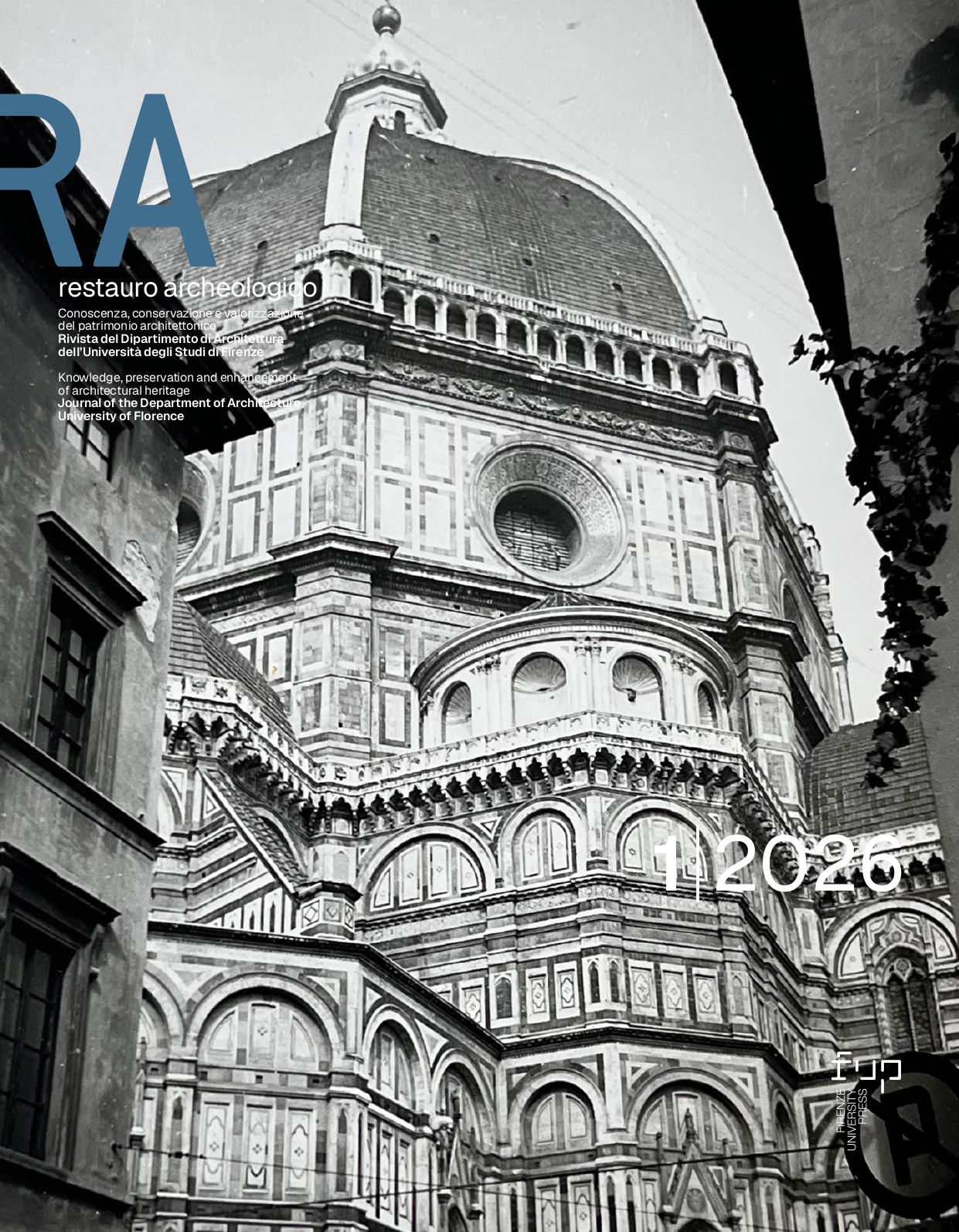
Published 2026-08-06
Keywords
- Piero Sanpaolesi,
- Dome of Santa Maria del Fiore,
- architectural restoration,
- architectural history,
- restoration culture
How to Cite
Copyright (c) 2026 Pierpaolo Lagani

This work is licensed under a Creative Commons Attribution 4.0 International License.
Abstract
Piero Sanpaolesi’s long engagement with the Dome of Santa Maria del Fiore constitutes one of the most significant intellectual laboratories in the formation of twentieth-century Italian restoration culture. Rather than treating the Dome as a celebrated object within Brunelleschian historiography, Sanpaolesi approached it as a historical and material organism to be understood through the continuous interplay of documentary sources, direct observation of the fabric, and reconstruction of the building process. From his early studies of the 1930s to the later writings of the 1970s, the Dome became the site in which a specifically restoration-oriented form of knowledge took shape. This article retraces that trajectory by focusing on three major moments: the revision of the Brunelleschian myth and of the 1418–1420 competition documents; the widening of the inquiry toward Brunelleschi’s technical culture, including statics, mechanics, and mathematical knowledge; and the later analysis of constructive problems such as curvature, the double shell, and the herringbone brick pattern. Read in this perspective, Sanpaolesi’s work shows how architectural history may turn into an operative knowledge of the monument, capable of grounding conservation in the understanding of its material, structural, and historical reality. The Dome thus emerges not only as a major object of study, but as the place in which knowing the monument already becomes a form of care.