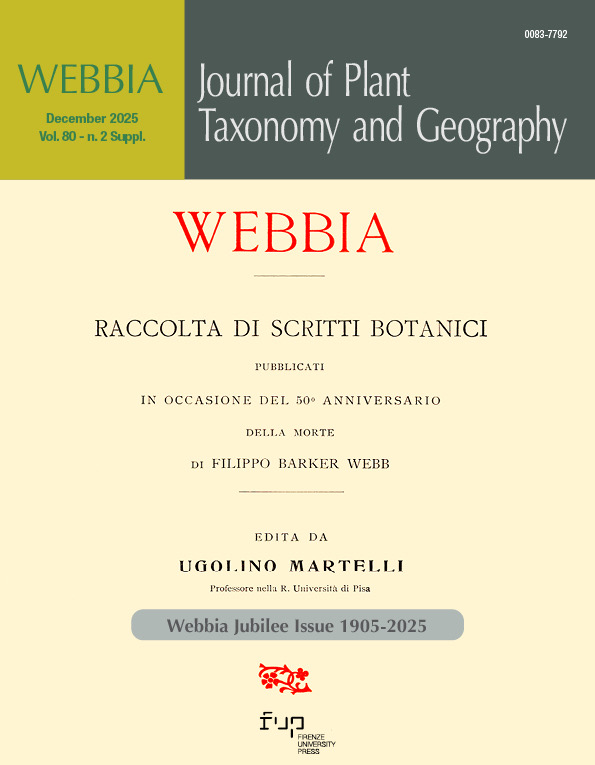

2025-11-30
About
The Journal of Plant Taxonomy and Geography (Webbia) is a full open access peer-reviewed journal on Plant Systematics, Nomenclature, Phylogeny, Phytogeography contributions deal with the Vascular Plants. It aims to allow research in botanical topics such as Taxonomy, Nomenclature, Systematics, Molecular Phylogeny, Conservation, Biogeography, and History fo Botany and Botanical collections.
Change in the Editorial team of Webbia
With this issue, there is some important news about Webbia’s editorial team.
After many years of dedicated service as Editor-in-Chief of Webbia and of fundamental research activity in plant systematics, Professor Riccardo Baldini has retired. His contribution to the journal has been both remarkable and long-standing: he served as editorial staff member for 16 years (1992–2008) and, subsequently as Editor-in-Chief for 17 years (2008–2025). That makes more than three decades of continuous commitment, during which he guided Webbia through significant phases of development, strengthening its scientific profile, international visibility, and editorial quality. His meticulous attention extended even to the careful review of the final proof.
Under his leadership, the journal consolidated its position within the field of plant systematics and biodiversity research, while embracing innovation in publication practices and fostering continuity with the historical tradition of Webbia. Among his several lines of activity, scientific rigor was probably the most important.
On behalf of the Editorial Board, the publisher, and the broader community of authors and reviewers, we express our sincere gratitude to Professor Baldini for his exceptional service, intellectual guidance, and unwavering commitment to Webbia. His work has significantly contributed to maintaining the journal’s scientific integrity and prestige. We hope that he will assist us also in the next years.
Following this transition, the editorial leadership of Webbia has been renewed. Since to substitute Prof. Baldini will be a very difficult task, we decided to form a triumvirate of editors. Professor Alessio Papini assumes the role of Editor-in-Chief, supported by two Co-Editors, Elisabetta Bianchi, expert in lichen systematics, and Lia Pignotti, curator of the tropical herbarium of Florence. The new editorial team is committed to ensuring continuity with the journal’s distinguished tradition while further strengthening its international outreach, scientific impact, and thematic breadth.
The mission of Webbia remains firmly rooted in the publication of high-quality research in plant systematics, taxonomy, phylogeny, biogeography, and biodiversity science. For this reason we hope that our authors, reviewers and readers will continue to show their interest for the journal and, possibly, to send us feedbacks about how to furtherly improve the visibility of the journal in the context of scientific literature.
With the addition of new Editorial Board members whose expertise extends beyond vascular plants, Webbia broadens its scientific scope. In addition to its established focus on the systematics and taxonomy of tracheophytes, the journal welcomes contributions on bryophytes, algae, fungi, lichens, and cyanobacteria, in continuity with its historical tradition.
Alessio Papini, Elisabetta Bianchi, Lia Pignotti
ISSN 0083-7792 (print) ISSN 2169-4060 (online)
Editor-in-Chief: Alessio Papini
Webbia is indexed in:





Announcements
2025-11-28
Change of Editor in Chief
Current IssueVol. 80 No. 2 Suppl. (2025)
Published November 17, 2025