

Morphometric analysis of Fusarium spp. isolates and relationship with pathogenic potential in banana Grande Naine (Musa sp. Cavendish) in Côte d'Ivoire
 B.W.M. Ouattara
- K.D. Kra
- B. Fofana
- A.C. Kouame
- H.A. Diallo
Published 2026-04-07
Keywords
- Correlation fungus,
- Fusarium,
- pathogenicity,
- postharvest disease
How to Cite
Copyright (c) 2026 Bognan Winnie Miyasi OUATTARA, Kouame Daniel KRA, Balakissa FOFANA, Ahou Christine KOUAME , Hortense Atta Diallo

This work is licensed under a Creative Commons Attribution 4.0 International License.




Abstract
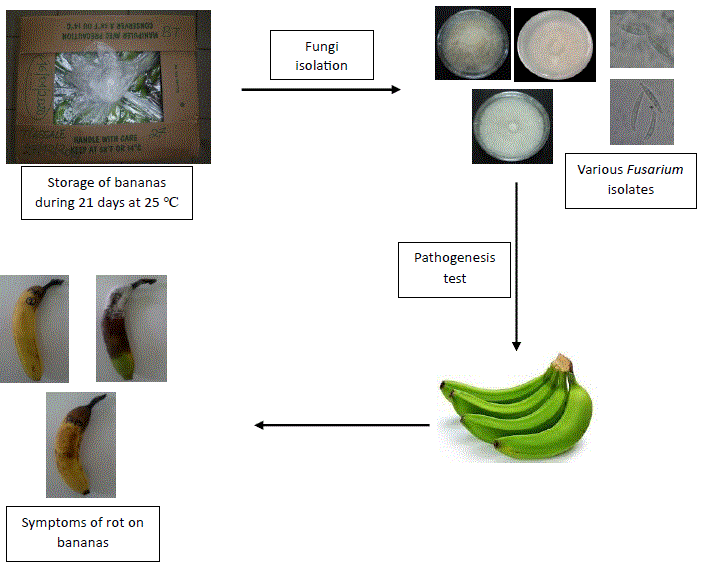
Fusarium is one of the best-known plant pathogenic fungi, particularly in bananas. This study was conducted to determine the variability of Fusarium isolates and their potential impact on banana quality in Côte d'Ivoire. Apparently healthy bananas were collected from the seven production localities and used to isolate the associated fungi. Morphological characterisation of the fungi included macroscopic (appearance, coloration and mycelial growth) and microscopic (presence or absence of septa, shape, size and conidial concentration) cultural characteristics. The pathogenicity of the isolates was assessed by the absence or presence of rotting symptoms on the bananas. The results showed that the coloration of the Fusarium isolates varied from white to yellow. Some isolates were cottony and thick, while others were flaky and carpeted. The mean macroconidia dimensions were 19.11-29.52 × 2.69-4.64 µm. The average number of septa in macroconidia ranged from 3-5 septa. Macroconidia were fusiform with pointed ends; microconidia were oval with one or two pointed ends. Among the morphometric characteristics of Fusarium isolates, the number and size of macroconidia was the most important discriminating traits for differentiating isolates. In terms of pathogenecity, all isolates caused a symptom except the one isolated in the Dabou area, which did not cause any symptoms. The incubation period varied from 10 to 16 days depending on the isolate.
References
- ARIAS P., DANKERS C., LIU P., PILKAUSKAS P., 2003 - The world banana economy 1985-2002. - FAO, Food and Agriculture Organisation of the United Nations, Rome, Italy, pp. 102.
- BALALI G.R., IRANPOOR M., 2006 - Identification and genetic variation of Fusarium species in Isfahan, Iran, using pectic zymogram technique. - Iran J. Sci. Technol. A, 30: 91-102.
- CHAUVIN E., JONCHERAY M., VALETTE H., BONNASSIEUX A., NOUR C.-H.B., 2025 - La banane de Côte d’Ivoire: Les recompositions d’une filière agro-industrielle mondialisée. - EchoGéo, 73: 1-28. DOI: https://doi.org/10.4000/14qwx
- CHOI Y.W., HYDE K.D., HO W.H., 1999 - Single spore isolation of fungi. - Fungal Diversity, 3: 29-38.
- COATES L., JOHNSON G., 1997 - Postharvest diseases of fruit and vegetables, 533-548. - In: BROWN J., and H. OGLE (eds.) Plant pathogens, plant diseases. Botany Department University of New England, Cocos Islands, Keeling, Australia.
- DOHOU N., YAMANI K., BADOC A., DOUIRA A., 2004 - Activité antifongique d’extraits de Thymelea lythroides sur trois Champignons du Riz. - Bull. Soc. Pharm., Bordeaux, France, 143: 31-38.
- DUNCAN C., TORRENCE L., 1992 - Techniques for rapid detection of plant pathology. - Blackwell Scientific Publication, Oxford, UK, pp. 234.
- FAO, 2022 - FAOSTAT. - FAO, Food and Agriculture Organization of the United Nations, https://www.fao.org/faostat/
- HEIT S., 2015 - Identification de Fusarium et détection des mycotoxines associées par MALDI-TOF. - Thèse de doctorat en pharmacie, Université de Laurraine, Nancy Cedex, France, pp. 128.
- KOUAME L.K., KANPIGNI K.A.B., 2022 - Analyse sanitaire et phytosanitaire des filières fruitières en Côte d’Ivoire. Cas de la mangue, l’ananas et la banane. - HortiFresch, pp. 76.
- KOUASSI K.S., 2001 - Les secteurs banane (AAA) et banane plantain (AAB) en Côte d’Ivoire: Analyse biblio-graphique et prospective. - CNRA Eds., Abidjan, Côte d’Ivoire, pp. 35.
- KRA K.D., MUKETOU M.A., TOUALY M.N.Y., KOUAKOU Y.Y.F., ATTA D.H., 2018 - Comparative effectiveness of three systemic fungicides on the fungi responsible for the cavendish subgroup grande naine banana post-harvest diseases in Côte d’Ivoire. - Int. J. Adv. Res., 6(3): 347-353. DOI: https://doi.org/10.21474/IJAR01/6685
- LASSOIS L., BUSOGORO J.P., JIJAKLI H., 2009 - La banane: De son origine à sa commercialisation. - Biotechnol. Agro. Soc. Environ., pp. 575-586.
- LASSOUDIÈRE A., 2007 - Le bananier et sa culture. - Quae Edition, Versailles, France, pp. 383.
- LESLIE J.F., SUMMERELL B.A., 2006 - The Fusarium laboratory manual. - Blackwell, Ames, IA, USA, pp. 288. DOI: https://doi.org/10.1002/9780470278376
- LI C.H., CERVANTES M., SPRINGER D.J., BOEKHOUT T., RUIZ-VAZQUEZ R.M., TORRES-MARTINEZ S.R., HEITMAN J., LEE S.C., 2011 - Sporangiospore size dimorphism is linked to virulence of Mucor circinelloides. - PLoS Pathog. 7(6): e1002086. DOI: https://doi.org/10.1371/journal.ppat.1002086
- MEDDAH N., OUAZZANI T.A., BENKIRANE R., DOUIRA A., 2010 - Mycoflore associée au bananier (Musa acuminata L.), variété Grande naine, cultivé sous serre dans la région du Gharb (Maroc). - Bull. Inst. Sci., Rabat, Sect. Sci. Vie., 32(1): 1-11.
- NATH K., SOLANKY K.U., BALA M., KUMAWAT G.L., 2014 - Post-harvest deterioration of banana fruits and its control using Fungicides. - Int. J. Plant Prot., 7: 345-348. DOI: https://doi.org/10.15740/HAS/IJPP/7.2/345-348
- NELSON P.E., TOUSSOUN T.A., COOK R.J., 1981 - Fusarium: Diseases, biology and taxonomy. University Park, Pennsylvania State University Press, PA, USA, pp. 446-452.
- ODAME A.E., 2010 - Occurence and pathogenicity of crown rot disease organisms in major banana producing areas in Ashanti region. - Thesis, University of Ghana, Ghana, pp. 96.
- PLOETZ R.C., 2006 - Fusarium-induced diseases of tropical, perennial crops. - Phytopathol., 96: 648-652. DOI: https://doi.org/10.1094/PHYTO-96-0648
- PLOETZ R.C., THOMAS J. E., SLABAUGH W.R., 2003 - Diseases of banana and plantain, pp. 73-134. - In: PLOETZ R.C. (ed.) Diseases of tropical fruit crops. CABI Publishing, Wallingford, UK, pp. 527. DOI: https://doi.org/10.1079/9780851993904.0073
- RUIZ-ROLDÁN M.C., KÖHLI M., RONCERO M.I., PHILIPPSEN P., DI PIETRO A., ESPESO E.A., 2010 - Nuclear dynamics during germination, conidiation, and hyphal fusion of Fusarium oxysporum. Eukaryot Cell., 9(8): 1216-1224. DOI: https://doi.org/10.1128/EC.00040-10
- ZAKARIA L., WAN CHIK M., WAI HENG K., SALLE B., 2012 - Fusarium species associated with fruit rot of Banana (Musa spp.), Papaya (Carica papaya) and Guava (Psidium guajava). - Mal. J. Microbiol., 8(2): 127-130. DOI: https://doi.org/10.21161/mjm.03812