

Novel sweet potato hybrids with enhanced anthocyanin accumulation and resistance to Sweet Potato Feathery Mottle Virus (SPFMV): Sweetpotato Hybrids with Enhanced Anthocyanin Accumulation and Resistance to SPFMV
 A. Lalusin
Published 2026-04-07
Keywords
- Anthocyanin,
- sweet potato feathery mottle virus (SPFMV),
- sweet potato hybrids
How to Cite
Copyright (c) 2025 Antonio Lalusin, Aura Heredia, Lara Jaaziel Batalon-Gavina

This work is licensed under a Creative Commons Attribution 4.0 International License.




Abstract
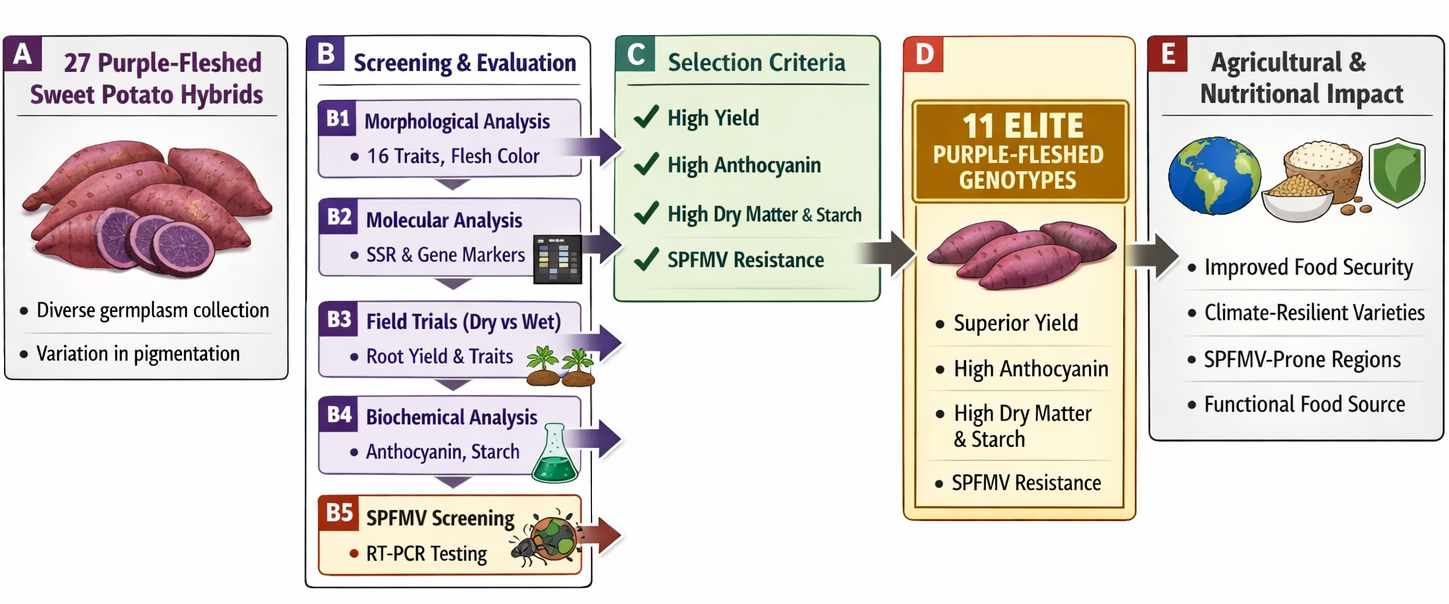
Sweet potato, a top five global crop with over 95% of production in developing countries, surpasses wheat, rice, and cassava in yield, nutrition, adaptability, and stress tolerance, providing more edible energy per hectare and contributing significantly to food security. Purple-fleshed sweet potatoes (PFSP) have a rich, deep purple color due to the presence of anthocyanins, which are antioxidants that have numerous health benefits. The flavor is like other sweet potatoes but can have a slightly more earthy or nutty taste, depending on the variety. Purple sweet potatoes are nutritious, being high in fiber, vitamins, and antioxidants. They can be used in various dishes, from baked and mashed forms to soups, fries, and even desserts. Molecular characterization, using SSR markers, indicated significant genetic diversity among the genotypes. Specific markers for the types of anthocyanin and resistance to Sweet potato Feathery Mottle Virus (SPFMV) were utilized to screen for promising lines. Yield trials conducted over multiple seasons showed notable differences in root count and weight, with purple-fleshed genotypes generally outperforming others, particularly during the dry season. Biochemical analysis further confirmed the high anthocyanin content in these purple-fleshed varieties, which also exhibited better yields during the dry season. Fifteen high-yielding genotypes were screened for resistance to SPFMV. The results, confirmed by SPFMV2-specific markers, showed that these genotypes were tolerant to the virus. Despite the virus’s presence, these genotypes continued to perform well, making them strong candidates for cultivation in regions affected by SPFMV. Based on their morphological traits, yield performance, biochemical properties, and virus resistance, 11 purple-fleshed genotypes were identified as top performers. These genotypes hold great potential for improving sweet potato production and food security in developing countries, where they can contribute to increased yields, enhanced nutritional value, and greater resilience to viral diseases.
References
- AMOANIMAA-DEDE H., SU C., YEBOAH A., CHEN C., YANG S., ZHU H., CHEN M., 2020 - Flesh color diversity of sweet potato: An overview of the composition,functions, biosynthesis, and gene regulation of the major pigments. - Phyton. Int. J. Exp. Bot., 89(4): 805-833. DOI: https://doi.org/10.32604/phyton.2020.011979
- ASHS, 2007 - Sweet potato promises hunger relief in developing countries. - Science Daily. Amer. Soc. Hort. Sci., 2007 www.sciencedaily.com/releases/2007/ 11/071102084811.htm
- AYELESO T.B., RAMACHELA K., MUKWEVLO E., 2016 - A review of therapeutic potentials of sweet potato: Pharmacological activities and influence of the cultivar. - Tropical J. Pharm. Res., 15(12): 2751-2761. DOI: https://doi.org/10.4314/tjpr.v15i12.31
- CHANDRASEKARA A., KUMAR T.J., 2016 - Roots and tuber crops as functional foods: A review on phytochemical constituents and their potential health benefits. - Inter. J. Food Sci., 1-15. DOI: https://doi.org/10.1155/2016/3631647
- CHOWDHURY M., NGO V.D., ISLAM M.N., ALI M., ISLAM S., RASOOL K., PARK S., CHUN G., 2021 - Estimation of glucosinolates and anthocyanins in kale leaves grown in a plant factory using spectral reflectance. - Horticulturae, 3(7): 10.3390. DOI: https://doi.org/10.3390/horticulturae7030056
- CIP, 2023 - Sweetpotato facts and figures. - CIP, International Potato Center, La Molina, Lima, Perù.
- CLARK C., DAVIS J.A., ABAD J.A., CUELLAR W.I., FUENTES S., KREUZE J.F., GIBSON R.W., MUKASA S.B., TUGUME A.K., TAIRO F.D., 2012 - Sweet potato viruses: 15 years of progress on understanding and managing complex diseases. - Plant Disease, 96(2): 168-185. DOI: https://doi.org/10.1094/PDIS-07-11-0550
- DOYLE J.J., DOYLE J.L., 1987 - A rapid DNA isolation procedure for small quantities of fresh leaf tissue. - Phytochem. Bulletin, 19: 11-15.
- GUTIÉRREZ D.L., FUENTES S., SALAZAR L.F., 2003 - Sweetpotato Virus Disease (SPVD): Distribution, incidence, and effect on Sweetpotato yield in Peru. - Plant Dis., 87(3): 297-302. DOI: https://doi.org/10.1094/PDIS.2003.87.3.297
- HUAMAN Z., 1999 - Systematic botany and morphology of the Sweetpotato plant, pp. 1-16. In: HUAMAZAN Z. (ed.) Sweetpotato germplasm management (Ipomea batatas). Training manual. CIP, International Potato Center, Lima, Perù, pp. 218.
- JIANG S., FENG J., ZHANG M., WANG S., XIN Z., XIN X., 2018 - Development of RT-LAMP assay for rapid detection of Sweet potato feathery mottle virus (SPFMV). - Scientia Agric. Sinica, 51(7): 1294-1302.
- KHAN A., JALIL S., CAO H., TSAGO Y., SUNUSI M., CHEN Z., SHI C., JIN X., 2020 - The purple leaf (pl6) mutation regulates leaf color by altering the anthocyanin and chlorophyll contents in rice. - Plants, 9(11): 1477. DOI: https://doi.org/10.3390/plants9111477
- KHOO H.E., AZLAN A., TANG S.T., LIM S.M., 2017 - Anthocyanidins and anthocyanins: Colored pigments as food, pharmaceutical ingredients, and the potential health benefits. - Food Nutr. Res., 61(1): 1361779. DOI: https://doi.org/10.1080/16546628.2017.1361779
- KREUZE J., FUENTES S., 2008 - Sweetpotato Viruses, pp. 661-669. Encyclopedia of Virology. - Academic Press, Elsevier Ltd., The Netherlands. DOI: https://doi.org/10.1016/B978-012374410-4.00647-6
- KREUZE J.F., 2002 - Molecular studies on the sweet potato virus diseases and its two causal agents. - Doctoral Dissertation, Department of Plant Biology, Uppsala, Sweden, pp. 63.
- LIAO M., ZOU B., CHEN J., YAO Z., HUANG L., LUO Z., WANG Z., 2019 - Effect of domestic cooking methods on the anthocyanins and antioxidant activity of deeply purple-fleshed sweetpotato GZ9. - Heliyon, 5(4): 1-17. DOI: https://doi.org/10.1016/j.heliyon.2019.e01515
- MANO J.F., SILVA G.A., AZEVEDO H.S., MALAFAYA P.B., SOUSA R.A., SILVA S.S., BOESEL L.F., OLIVEIRA J.M., SANTOS T.C., MARQUES A.P., NEVES N.M., REIS R.L., 2007 - Natural origin biodegradable systems in tissue engineering and regenerative medicine: present status and some moving trends. - J. Royal Soc. Interface, 4: 999-1030. DOI: https://doi.org/10.1098/rsif.2007.0220
- MENG Y., ZHAO N., LI H., ZHAI H., HE S., LIU Q., 2018 - SSR fingerprinting of 203 sweetpotato (Ipomoea batatas (L.) Lam.) varieties. - J. Integrative Agric., 17(1): 86-93. DOI: https://doi.org/10.1016/S2095-3119(17)61687-3
- NCPN, 2016 - Sweet potato virus. - NCIPN, National Clean Plant Network, www.nationalcleanplantnetwork. org/sweetpotato-virus.
- PARK Y.S., BAE D.W., RYU C.M., 2015 - Aboveground whitefly infestation modulates transcriptional levels of anthocyanin biosynthesis and jasmonic acid signaling-related genes and augments the cope with drought stress of maize. - PLOS One, 10(12): e0143879. DOI: https://doi.org/10.1371/journal.pone.0143879
- PRASANTH G., HEGDE V., 2008 - Occurrence of Sweetpotato feathery mottle virus and Sweet potato leaf curl Georgia virus on Sweet Potato in India. - Plant Dis., 92(2): 311. DOI: https://doi.org/10.1094/PDIS-92-2-0311B
- SIM J., VALVERDE R.A., CLARK C.A., 2000 - Whitefly transmission of Sweetpotato chlorotic stunt virus. - Plant Dis. 84(11): 1250. DOI: https://doi.org/10.1094/PDIS.2000.84.11.1250C
- SIVPARSAD B., AUGUSTINE GUBBA A., 2013 - Development of transgenic sweet potato with multiple virus resistance in South Africa (SA). - Transgenic Res., 23(2): 377-388. DOI: https://doi.org/10.1007/s11248-013-9759-7
- SUDA I., OKI T., MASUDA M., KOBAYASHI M., NISHIBA Y., FURUTA S., 2003 - Physiological functionality of purple-fleshed sweet potatoes containing anthocyanins and their utilization in foods. - JARQ, 37(3): 167-173. DOI: https://doi.org/10.6090/jarq.37.167
- TERAHARA N., KONCZAK I., ONO H., YOSHIMOTO M., YAMAKAWA O., 2004 - Characterization of acylated anthocyanins in callus induced from storage root of purple-fleshed sweet potato, Ipomoea batatas L. - J. Biomed. Biotechn., 2004(5): 279-286. DOI: https://doi.org/10.1155/S1110724304406056
- TIAN Q., KONCZAK I., SCHWARTZ S.J., 2005 - Probing anthocyanin profiles in purple sweet potato cell line (Ipomoea batatas L. Cv. Ayamurasaki) by high-performance liquid chromatography and electrospray ionization tandem mass spectrometry. - J. Agric. Food Chem., 53(16): 6503-6509. DOI: https://doi.org/10.1021/jf050671m
- WILSON J.E., POLE F.S., NEJM S., TAUFATOFUA P., 1989 - Sweet potato (Ipomoea batatas) breeding. - IRETA Publications. FAO Root Crops Development Systems Project RAS/86/034.
- WU X., BEECHER G.R., HOLDEN J.M., HAYTOWITZ D.B., GEBHARDT S.E., PRIOR R.L., 2006 - Concentrations of anthocyanins in common foods in the United States and estimation of normal consumption. - J Agric Food Chem., 54(11): 4069-4075. DOI: https://doi.org/10.1021/jf060300l
- ZHAO F., ZHANG Z., LI H., QIAO Q., WANG S., TIAN Y., WANG Y., QIN Y., ZHANG D., 2020 - First report of sweet potato feathery mottle virus infecting Amaranthus blitum in China. - J. Plant Pathol., 102: 965. DOI: https://doi.org/10.1007/s42161-020-00533-2