


Published 2026-07-27
Keywords
- Greenhouse energy reduction,
- low-temperature acclimatation,
- plant growth regulators,
- salicylic acid,
- tomato transplant quality
How to Cite
Copyright (c) 2026 Jamal Javanmardi, Jorge M. Vivanco

This work is licensed under a Creative Commons Attribution 4.0 International License.




Abstract
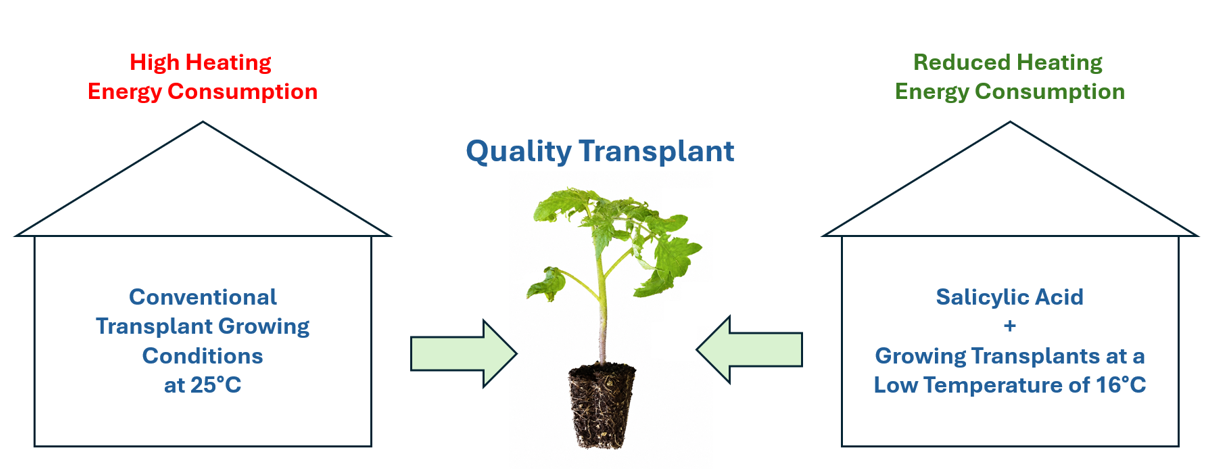
The economic and environmental pressures associated with greenhouse heating for warm-season vegetable transplant production have prompted a search for biologically driven, cost-effective alternatives. This study investigates the potential of exogenously applied salicylic acid (SA), a phenolic phytohormone known for its stress-mitigating properties, to reduce energy consumption by enhancing seedling cold tolerance. Tomato seedlings (Solanum lycopersicum cv. Rutgers) were subjected to three concentrations of foliar-applied SA (0, 75, and 150 mg/L) and grown under two temperature regimes 16°C and 25°C, in growth chambers. Transplant morphological parameters, including shoot and root biomass, stem thickness, leaf development, and root system architecture, were analyzed over a 49-day growth cycle. At 16°C, application of 75 mg/L SA significantly enhanced seedling vigor, with shoot fresh weight, stem diameter, and leaf area comparable to those grown at standard commercial conditions of 25°C without SA. SA-treated seedlings exhibited enhanced root biomass and surface area, indicating improved cold tolerance. Importantly, energy modeling indicated that reducing the heating setpoint from 25°C to 16°C could lower heating energy requirements by approximately 45%, a savings enabled by the physiological benefits of SA. These findings underscore the dual role of SA as both a growth regulator and an abiotic stress mitigator, suggesting that targeted SA application could transform transplant production by reducing reliance on costly supplemental heating. This represents a novel integration of plant physiological intervention into sustainable energy management practices in horticulture.
References
- ABD-ELKADER D.Y., MOHAMED A.A., FELEAFEL M.N., AL-HUQAIL A.A., SALEM M.Z.M., ALI H.M., HASSAN H.S., 2022 - Improvement of tomato performance under low temperature stress using acetylsalicylic acid and potassium silicate - Zagazig J. Agric. Res., 49(2): 353-366.
- AGHDAM M.S., ASGHARI M., KHORSANDI O., MOHAYEJI M., 2014 - Alleviation of postharvest chilling injury of tomato fruit by salicylic acid treatment. - J. Food Sci. Techn., 51: 2815-2820.
- ASGARI N., HAYIBO K.S., GROZA J., RANA S., PEARCE J.M., 2025 - Greenhouse applications of solar photovoltaic driven heat pumps in northern environments. - Ren. Sust. Energy Rev., 207: 114920.
- BAGAUTDINOVA Z.Z., OMELYANCHUK N., TYAPKIN A.V., KOVRIZHNYKH V.V., LAVREKHA V.V., ZEMLYANSKAYA E.V., 2022 - Salicylic acid in root growth and development. - Int. J. Mol. Sci., 23(4): 2228.
- CHAKMA R., BISWAS A., SAEKONG P., ULLAH H., DATTA A., 2021 - Foliar application and seed priming of salicylic acid affect growth, fruit yield, and quality of grape tomato under drought stress. - Scientia Horticulturae, 280: 109904.
- DE ZWART F., VANTHOOR B., KORENEEF S., 2019 - Tuinbouw zonder fossiele energie. - Wageningen Plant Research, Rapport No. WPR-853, pp. 62.
- DJEVIC M., DIMITRIJEVIC A., 2009 - Energy consumption for different greenhouse constructions. - Energy, 34(9): 1325-1331.
- ESEN M., YUKSEL T., 2013 - Experimental evaluation of using various renewable energy sources for heating a greenhouse. - Energy Buildings, 65: 340-351.
- FAOSTAT, 2026 - Crops and Livestock Products: Tomatoes, production 2024. - FAO, Food and Agriculture Organization of the United Nations, Rome, Italy.
- FENG Y., LI Z., KONG X., KHAN A., ULLAH N., ZHANG X., 2025 - Plant coping with cold stress: molecular and physiological adaptive mechanisms with future perspectives. - Cells, 14(2): 110.
- GALVIZ Y.C., BORTOLIN G.S., GUIDORIZI K.A., DEUNER S., REOLON F., MUNT DE MORAES D., 2021 - Effectiveness of seed priming and soil drench with salicylic acid on tomato growth, physiological and biochemical responses to severe water deficit. - J. Soil Sci. Plant Nutr., 21: 2364-2377.
- GHAHREMANI Z., ALIZADEH B., BARZEGAR T., NIKBAKHT J., RANJBAR M.E., NEZAMDOOST D., 2023 - The mechanism of enhancing drought tolerance threshold of pepper plant treated with putrescine and salicylic acid. - Plant Stress, 9: 100199.
- GHARIB F.A., HEGAZI A.Z., 2010 - Salicylic acid ameliorates germination, seedling growth, phytohormone and enzymes activity in bean (Phaseolus vulgaris L.) under cold stress. - J. Amer. Sci., 6(10): 675-683.
- HATFIELD J.L., PRUEGER J.H., 2015 - Temperature extremes: Effect on plant growth and development. - Weather Climate Extremes, 10(A): 4-10.
- HAYAT S., HAYAT Q., ALYEMENI M.N., WANI A.S., PICHTEL J., AHMAD A., 2013 - Role of salicylic acid in plant response to abiotic stress. - Biologia Plant., 57(3): 447-456.
- HUBER B.M., LOUWS F.J., HERNÁNDEZ R., 2021 - Impact of different daily light integrals and carbon dioxide concentrations on the growth, morphology, and production efficiency of tomato seedlings. - Frontiers Plant Sci., 12: 615853.
- JANDA T., HORVÁTH E., SZALAI G., PALDI E., 2007 - Role of salicylic acid in the induction of abiotic stress tolerance, pp. 91-150. - In: HAYAT S. and A. AHMAD (eds.) Salicylic acid - A plant hormone. Springer, Dordrecht, Germany, pp. 401.
- JAVANMARDI J., AKBARI N., 2016 - Salicylic acid at different plant growth stages affects secondary metabolites and physico-chemical parameters of greenhouse tomato. - Adv. Hort. Sci., 30(3): 151-158.
- JAVANMARDI J., MORADIANI M., 2017 - Tomato transplant production method affects plant development and field performance. - Int. J. Veg. Sci., 23: 31-41.
- JAVANMARDI J., RAHEMI M., NASIRZADEH M., 2013 - Physiological and reproductive responses of tomato and pepper transplants to low-temperature conditioning. - Int. J. Veg. Sci., 19(3): 294-310.
- KOZAI T., 2005 - Closed systems for high quality transplants using minimum resources, pp. 275-312. - GUPTA S.D. and Y. IBARAKI (eds.). Plant culture engineering. Springer, Dordrecht, Germany, pp. 480.
- KUBOTA C., MCCLURE M.A., KOKALIS-BURELLE N., BAUSHER M.G., ROSSKOPF E.N., 2008 - Vegetable grafting: History, use, and current technology status in North America. - HortScience 43: 1664-1669.
- LESKOVAR D.I., 2020 - Transplanting, pp. 631-659. - In: WIEN H.C., and H. STÜTZEL (eds.) The physiology of vegetable crops. CABI, Wallingford, UK, pp. 497.
- LI A., SUN X., LIU L., 2022 - Action of salicylic acid on plant growth. - Front. Plant Sci., 13, 878076.
- LUO J., LI A., MA X., PEI K., 2023 - Stabilization of the temperature in a greenhouse using a Geothermal-Battery-Energy-Storage (GBES) system. - Appl. Thermal Eng., 223: 120029.
- MOHAMMADI C., JAMIL I., FATAH Y., 2023 - Reinforcing pepper (Capsicum annuum) growth by gypsum and salicylic acid under salinity stress. - J. Agric. Sci., 15(2): 483-490.
- NISHAD S., KRUPA I., 2022 - Phase change materials for thermal energy storage applications in greenhouses: A review. - Sustain. Energy Technol. Assess, 52: 102241.
- PRIETO J., AJNANNADHIF R.M., FERNÁNDEZ-DEL OLMO P., CORONAS A., 2023 - Integration of a heating and cooling system driven by solar thermal energy and biomass for a greenhouse in Mediterranean climates. - Appl. Thermal Engineering, 221: 119928.
- PROTOCOL K., 1997 - Kyoto protocol to the United Nations framework convention on climate change. - https://unfccc.int/resource/docs/convkp/kpeng.pdf
- RIVAS-SAN VICENTE M., PLASENCIA J., 2011 - Salicylic acid beyond defence: Its role in plant growth and development. - J. Exper. Bot., 62(10): 3321-3338.
- SAFARI M., MAJIDI M.M., 2025 - Role of genetic diversity and salicylic acid in drought stress memory of tall fescue. - Scientific Reports, 15(1): 7932.
- SALEEM M., FARIDUDDIN Q., JANDA T., 2021 - Multifaceted role of salicylic acid in combating cold stress in plants: A review. - J. Plant Growth Regul., 40: 464-485.
- SOUSA V.F.O., SANTOS A.S., SALES W.S., SILVA A.J., GOMES F.A.L., DIAS T.J., GONÇALVES-NETO A.C., FARAZ A., SANTOS J.P.O., SANTOS G.L., CRUZ J.M.F.L., SILVA L.D.R., 2024 - Exogenous application of salicylic acid induces salinity tolerance in eggplant seedlings. - Brazilian J. Biol., 84: e257739.
- STANGHELLINI C., VAN’T OOSTER B., HEUVELINK E., 2024 - Greenhouse horticulture: Technology for optimal crop production. - Brill, Wageningen Academic, Wageningen, The Netherlands, pp. 315.
- SUN W., WEI X., ZHOU B., LU C., GUO W., 2022 - Greenhouse heating by energy transfer between greenhouses: System design and implementation. - Appl. Energy, 325: 119815.
- THILAKARATHNE A.S., LIU F., ZOU Z., 2025 - Plant signaling hormones and transcription factors: Key regulators of plant responses to growth, development, and stress. - Plants, 14(7): 1070.
- WANG L., ZHANG C., 2021 - Greenhouse microclimate control strategy to reduce costs based on improved NSGA-II optimal method. - Engineering Letters, 29(3).
- XU W., GUO H., MA C., 2022 - An active solar water wall for passive solar greenhouse heating. - Appl. Energy, 308: 118270.
- ZHANG M., YAN T., WANG W., JIA X., WANG J., KLEMEŠ J.J., 2022 - Energy-saving design and control strategy towards modern sustainable greenhouse: A review. - Renew. Sustain. Energy Rev., 164: 112602.
- ZHANG Y., LI X., WANG Q., LIU H., 2023 - Salicylic acid enhances low-temperature stress tolerance in eggplant seedlings by improving photosynthetic efficiency and antioxidant capacity. - Plant Physiol. Reports, 28(1): 45-54.
- ZHU J., ZHANG X., HUA W., JI J., LV X., 2023 - Current status and development of research on phase change materials in agricultural greenhouses: A review. - J. Energy Storage, 66: 107104.