
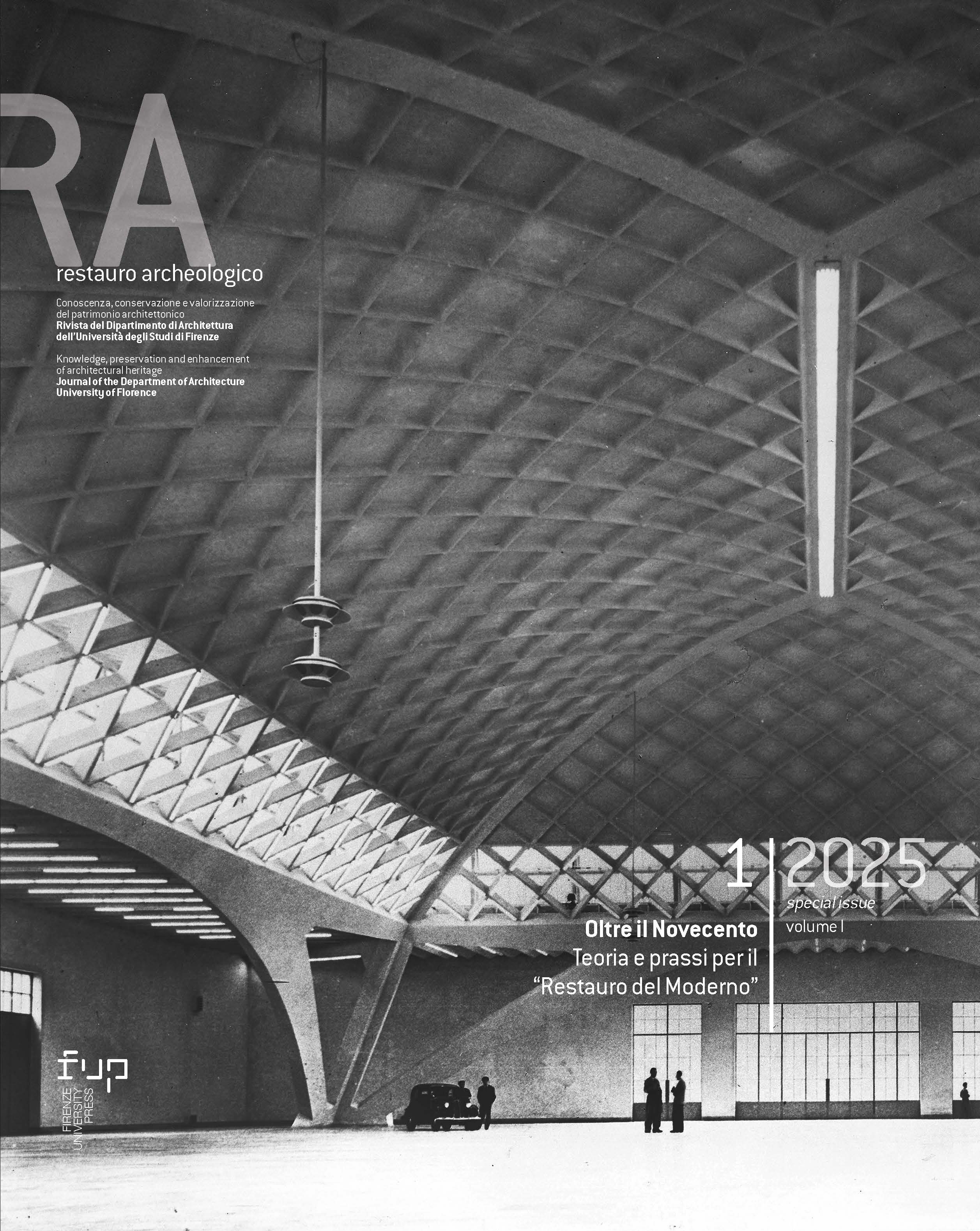
Conservare il Novecento. Ambiguità e contraddizioni nella stagione della sostenibilità / Preserving the Twentieth-Century Heritage. Ambiguities and contradictions in the era of sustainability
 Paola Bordoni
Published 2025-12-12
Keywords
- Restoration,
- Modern Heritage,
- Sustainability,
- Durability
How to Cite
Copyright (c) 2025 Paola Bordoni

This work is licensed under a Creative Commons Attribution 4.0 International License.
Abstract
The etymology of the word ‘durability’ refers to the properties of resistance and solidity (from the Latin durus), rather than durability (durabilis) and the ability to maintain its characteristics over time (durabilitas). The term recurs in research on materials and their performance, including reinforced concrete, for which early texts will in many cases affirm durable and economique properties. Today, ‘durability’ translates into French another term that has now entered the language of conservation, ‘sustainability’ (or durabilité), which extends beyond the ability to withstand the effects of time and welcomes a new meaning that includes environmental, social and economic aspects. If in the analysis of the relationships between sustainability and heritage, conservation practices are also called upon to redefine selection criteria, purposes of protection and operating methods. In relation to the architectural production of the twentieth century – which reflects the stimuli and orientations of the society of the last century – the issues that arise are mainly epistemological in nature and contrast with experimental research, serial production cycles and industrial construction sites, where the durability of materials is however limited by economic constraints and tight deadlines, and is reflected in the perishability of modern architecture, which was not designed to last over time. The contribution aims to reflect on theoretical, as well as operational, issues that a theme such as sustainability in the field of heritage conservation brings with it.