

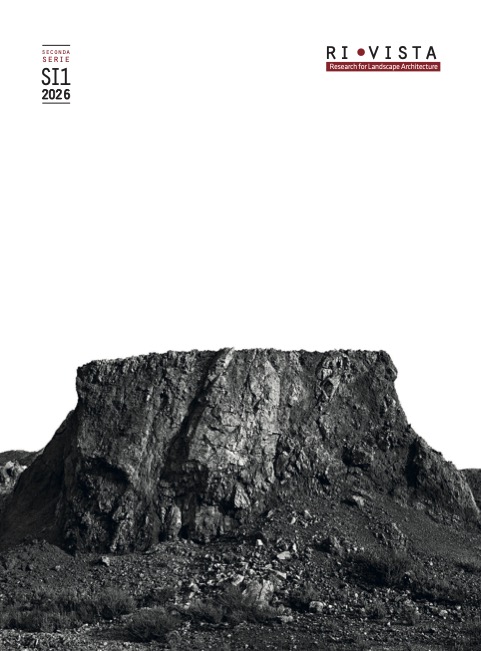
Il dilemma della produzione: Rappresentare le scale nascoste dell’estrazione del Travertino Romano
Published 2026-07-11
Keywords
- Hydrogeology,
- Subsidence,
- Necropolitics,
- Critical cartography,
- Post-extractive landscape
How to Cite
Copyright (c) 2026 Sara Radi Ahmed

This work is licensed under a Creative Commons Attribution 4.0 International License.




Abstract
The Tiburtine landscape, shaped by travertine quarrying, reveals deep landscape conflicts. Dewatering practices lowered aquifers, disrupted groundwater levels, and damaged ecosystems, while subsidence and sinkholes compromised housing and infrastructure. Once productive, the quarries now appear as wastelands but hold potential as laboratories for ecological regeneration. Water and soil emerge as landscape actors and agents of resistance, capable of transforming extraction voids into biodiversity reservoirs and new forms of multispecies coexistence. This paper employs speculative mapping and critical readings to envision post-extractive futures, moving beyond restorative logics toward reclamation as an ecological and social rewriting of the landscape.
Il territorio tiburtino, segnato dall’estrazione del travertino, rivela un paesaggio di conflitti profondi. Le pratiche estrattive hanno abbassato la falda, alterato i livelli piezometrici e minacciato gli ecosistemi locali, mentre i processi di subsidenza e le doline hanno compromesso abitazioni e infrastrutture. Le cave, da spazi produttivi, si sono trasformate in terre di scarto, ma possiedono il potenziale per diventare laboratori di rigenerazione ecologica. Acqua e suolo emergono come attori paesaggistici e agenti di resistenza, capaci di ridefinire i vuoti estrattivi in serbatoi di biodiversità e nuove forme di coesistenza multi-specie. Questo saggio presenta mappe speculative e letture critiche come strumenti per immaginare scenari post-estrattivi, superando la logica riparativa per abbracciare la reclamation, intesa come riscrittura ecologica e sociale del paesaggio.
References
- Ahmed S.R., Capuano A. 2025, Blue infrastructures for ecological regeneration – The recovery of mining sites in Hamburg and Rome, «AGATHÓN | International Journal of Architecture, Art and Design», vol. 18, pp. 84–97.
- Ahmed S.R. 2025, Mapping the Void: Landscapes of Roman Travertine Extraction, PhD thesis, Department of
- Landscape and Environment, Sapienza University of Rome, non pubblicato.
- Armiero M. 2021, Wasteocene: stories from the global dump, Cambridge University Press, Cambridge. DOI: https://doi.org/10.1017/9781108920322
- Berger A. 2002, Representation and Reclaiming: Cartographies, Mappings, and Images of Altered American Western Landscapes, «Landscape Journal», vol. 21, n. 1, pp. 1–22. DOI: https://doi.org/10.3368/lj.21.1.1
- Billi A. et al. 2016, Hidden sinkholes and karst cavities in the travertine plateau of a highly populated geothermal seismic territory (Tivoli, central Italy), «Geomorphology», vol. 255, pp. 63–80. DOI: https://doi.org/10.1016/j.geomorph.2015.12.011
- Bono P. 2008, Stato evolutivo della falda acquifera regionale nella piana di Tivoli - Guidonia, Roma Tivoli Terme, 12 dicembre 2008 - Acque Albule - Victoria Terme Hotel Montecelio, non pubblicato.
- Bozzano F. et al. 2015, Understanding the subsidence process of a quaternary plain by combining geological and hydrogeological modelling with satellite InSAR data: The Acque Albule Plain case study, «Remote Sensing of Environment », vol. 168, pp. 219–238. DOI: https://doi.org/10.1016/j.rse.2015.07.010
- Burke A., Fishel S. 2020, Across Species and Borders: Political Representation, Ecological Democracy and the Non-Human, in J.C. Pereira, A. Saramago (eds), Non-Human Nature in World Politics, Springer International Publishing, Cham (Frontiers in International Relations), pp. 33–52. DOI: https://doi.org/10.1007/978-3-030-49496-4_3
- De Dominicis F. 2023, From Humboldt’s Chimborazo to Geddes’ Valley Section and Beyond: How a Cross-Section Oriented World Scale Ecologies, in A. Capuano et al. (eds), The landscape as union between art and science: the legacy of Alexander von Humboldt and Ernst Haeckel = Il paesaggio come unione tra arte e scienza: l’eredità di Alexander von Humboldt e Ernst Haeckel, Quodlibet, Marcerata, pp. 79–97. DOI: https://doi.org/10.2307/jj.4688107.7
- De Filippis L., Rossetti C., Billi A., Faccenna C. 2013, Uomo, georisorse e faglie nel bacino delle Acque Albule, Italia centrale, «Rendiconti Online della Società Geologica Italiana», vol. 27, pp. 86–97. DOI: https://doi.org/10.3301/ROL.2013.22
- Desimini J., Waldheim C. 2016, Cartographic grounds: projecting the landscape imaginary, Princeton Architectural Press, New York.
- Klein N. 2014, This changes everything: capitalism vs. the climate, Simon & Schuster, New York.
- Maxia C. 1950, Il bacino delle Acque Albule (Lazio), «Contributi di Scienze Geologiche Suppl. Ric. Sc. Univ. Roma», pp. 27–44.
- Mbembe A. 2019, Necropolitics, trad. di S. Corcoran, Duke University Press, Durham–London (Theory in Forms). DOI: https://doi.org/10.2307/j.ctv1131298
- Metta A. 2024, Adaptive reuse for leftover urban landscape: ruins, remains, waste and monsters for an approaching genealogy of future, «Journal of Cultural Heritage Management and Sustainable Development», vol. 14, n. 1, pp. 98–109. DOI: https://doi.org/10.1108/JCHMSD-07-2022-0118
- Sanjuán C.O. 2019, Landscape as Territory: Cartographic Design Book, Actar Publishers, Barcelona, New York, London.
- Svampa M. 2019, Neo-extractivism in Latin America: Socio-environmental Conflicts, the Territorial Turn, and New Political Narratives, Cambridge University Press, Cambridge. DOI: https://doi.org/10.1017/9781108752589
- Talento K., Amado M., Kullberg J.C. 2020, Quarries: From Abandoned to Renewed Places, «Land», vol. 9, n. 5, p. 136. DOI: https://doi.org/10.3390/land9050136
- Torres-Campos T. 2020, Inwood’s Geofollies - And Other Witnesses of Dissonance, in E. Wall (ed.), The Landscapists: Redefining Landscape Relations, John Wiley & Sons, Oxford (Architectural Design Profile), pp. 38–45. DOI: https://doi.org/10.1002/ad.2523
- Wall E. 2020, The Landscapists: Redefining Landscape Relations, John Wiley & Sons, Oxford (Architectural Design Profile, n. 263).