

Processi di riconversione dei territori estrattivi e rigenerazione paesaggistica. Il distretto lacustre della Bassa Lusazia in Germania
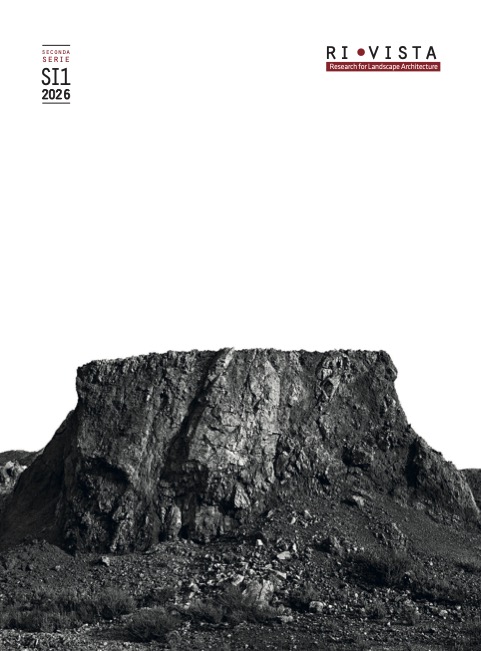
Published 2026-07-11
Keywords
- Lusatia,
- Lignite Mining,
- Landscape Regeneration,
- Post-Mining Landscapes,
- Lake District
How to Cite
Copyright (c) 2026 Paola Sabbion

This work is licensed under a Creative Commons Attribution 4.0 International License.




Abstract
The territory of Lower Lusatia, southeast of Berlin, has undergone profound transformations because of mining activities that began in the 19th century and were largely discontinued after German reunification. The closure of the mines made extensive reconversion measures necessary to address the region’s economic, social, and environmental challenges. Post-mining landscapes have been regenerated through reclamation projects, soil remediation, and the initiation of new ecological dynamics. Among the most significant transformations is the creation of the largest system of artificial lakes in Europe, resulting from the rising groundwater levels. These processes have triggered an unprecedented territorial transformation, converting mining scars into lake landscapes, forests, new tourism infrastructure, and renewable energy plants. The scale of the operations highlighted a solid capacity for long-term planning, supported by substantial resources. This paper analyses the historical evolution, environmental impacts, and reconversion strategies of Lusatia, aiming to understand the dynamics that have enabled this profound territorial reorganization and to discuss the region’s prospects.
Il territorio della Bassa Lusazia, a sud-est di Berlino, ha subito profonde trasformazioni a seguito delle attività estrattive iniziate nel XIX secolo e interrotte in gran parte dopo la riunificazione tedesca. La chiusura delle miniere ha sollevato la necessità di intraprendere ingenti opere di bonifica per affrontare le criticità economiche, sociali e ambientali della regione. I paesaggi post-minerari sono stati rigenerati attraverso interventi di riqualificazione, riconversione d’uso del suolo e avvio di nuove dinamiche ecologiche. Tra le trasformazioni più significative si distingue messa in opera del più esteso sistema di laghi artificiali d’Europa, originato dalla risalita delle falde acquifere. Tali processi hanno avviato una trasformazione territoriale senza precedenti, che ha convertito le cicatrici minerarie in paesaggi lacustri, foreste, nuove infrastrutture turistiche e impianti per energie rinnovabili. La scala delle operazioni ha reso evidente la necessità di tempi lunghi e di risorse ingenti. Il paper analizza l’evoluzione storica, gli impatti ambientali e le strategie di riconversione della Lusazia, con l’obiettivo di comprendere le dinamiche che hanno reso possibile una profonda riorganizzazione territoriale e di discutere le prospettive future della regione.
References
- Berkner A. 2000, The lignite industry and the reclamation of land-developments in the Rhenish, Central German and Lusatian mining areas since 1989, ≪Beitrage zur Regionalen Geographie≫, vol. 52, pp. 186-201.
- Deshaies M. 2020, Metamorphosis of Mining Landscapes in the Lower Lusatian Lignite Basin (Germany): New Uses and New Image of a Mining Region, ≪Les Cahiers de la recherche architecturale, urbaine et paysagère≫, <http://journals.openedition.org/craup/4018> (01/26). DOI: https://doi.org/10.4000/craup.4018
- Gerwin W., Raab T., Birkhofer K., Hinz C., Letmathe P., Leuchner M., Rude T., Trachte K., Watzold F., & Lehmkuhl F. 2023, Perspectives of lignite post-mining landscapes under changing environmental conditions: What can we learn from a comparison between the Rhenish and Lusatian region in Germany?, ≪Environmental Sciences Europe≫, vol. 35, n.1, pp. 1-24, < https://doi.org/10.1186/s12302-023-00738-z > (01/26). DOI: https://doi.org/10.1186/s12302-023-00738-z
- Krummelbein J., Bens O., Raab T., Anne Naeth M. 2012, A history of lignite coal mining and reclamation
- practices in Lusatia, eastern Germany, ≪Canadian Journal of Soil Science≫, vol. 92, n. 1, pp. 53-66, < https://doi.org/10.4141/cjss2010-063 > (01/26). DOI: https://doi.org/10.4141/cjss2010-063
- Quinkenstein A., Wollecke J., Bohm C., Grunewald H., Freese D., Schneider B. U., Huttl R. F. 2009, Ecological
- Benefits of the Alley Cropping Agroforestry System in Sensitive Regions of Europe, ≪Environmental Science & Policy≫, vol. 12, n. 8, 2009, pp. 1112-1121, <https://doi.org/10.1016/J.ENVSCI.2009.08.008 > (01/26). DOI: https://doi.org/10.1016/j.envsci.2009.08.008
- Schulte P., Hamacher H., Lehmkuhl F., Esser V. 2022, Initial soil formation in an artificial river valley—interplay of anthropogenic landscape shaping and fluvial dynamics, ≪Geomorphology≫, vol. 398, 2022, p. 108064, < https://doi.org/10.1016/j.geomorph.2021.108064 > (01/26). DOI: https://doi.org/10.1016/j.geomorph.2021.108064
- Topp W., Thelen K., Kappes H. 2010, Soil dumping techniques and afforestation drive ground-dwelling
- beetle assemblages in a 25-year-old open-cast mining reclamation area, ≪Ecological Engineering≫,
- vol. 36, n. 6, pp.751-756, < https://doi.org/10.1016/j.ecoleng.2009.12.011> (01/26).
- Tsiouti A. 2024, Generando patrimonio a partir de los escombros. La recuperación de los paisajes mineros
- en españa, [Tesi doctoral, Universitat Politecnica de Catalunya], UPCommons,
- upc.edu/entities/publication/cc717b17-4e5e-4bdeab95-c80a3ad15a8a> (01/26).
- Wirth P., Černič Mali B., Fischer W. (eds.) 2012, Post-Mining Regions in Central Europe, Problems, Potentials, DOI: https://doi.org/10.14512/9783865815002
- Possibilities, Oekom Verlag, Munchen.
- Wirth P., Lintz G. 2006, Rehabilitation and development of mining regions in Eastern Germany. Strategies and outcomes, ≪Moravian Geographical Reports», vol. 14, n. 2, pp. 69-82.
- Wolf K. S. 2012, Redesigning Wounded Landscapes: The IBA Workshop in Lausatia, Internationale Bauausstellung (IBA) Furst-Puckler-Land 2000-2010, Berlin.